We're excited to share that a collaboration between our lab and Brad Smith's group in Chemistry and Biochemistry has been published in Biomedical Optics Express: "Needle-injected wireless light-emitting device for 5-aminolevulinic acid-mediated photodynamic therapy of breast cancer."
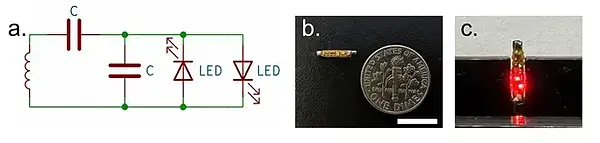
The study centers on a wireless implantable light-emitting device (WILD) that is small enough to fit through a 12-gauge biopsy needle and is powered by an external RF source. Ana F. de Almeida Barreto, Doctoral Candidate, and Sunghoon Rho, Ph.D., former lab member, played a key role in building the device, which carries two 632 nm LEDs and a tuned receiver coil and stayed functional through four rounds of treatment in mice. In a mouse model of triple-negative breast cancer, WILD-activated 5-ALA therapy reduced tumor burden, with signs of an immune response. Congratulations to everyone involved!
Read the paper: https://doi.org/10.1364/BOE.611984
Originally published by at osullivangroup.nd.edu on October 05, 2026.